According to McKinsey 41% of employees who quit cited a lack of a career path reason for leaving.
That’s a big number. And a big opportunity for you as a small business owner.
“Career architecture” is corporate-speak for something pretty simple:
- showing employees where they can grow,
- what they need to accomplish to get there,
- and how much more they can earn along the way.
And this isn’t just for corporate America. This is for positions like Sales Associates, Production Managers, and Office Managers.
Let’s Look at an example using a Residential Sales Associate (RSA)
Imagine showing RSA candidates this career path during their very first interview.
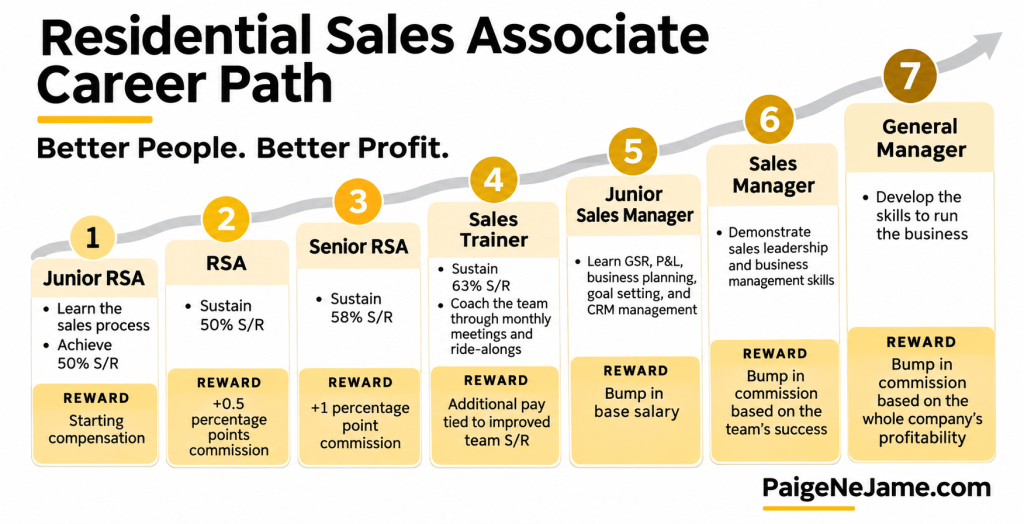
Feel free to download this image and print.
| Career Level | What It Takes | Reward |
|---|---|---|
| Junior RSA | Learn the sales process and achieve 50% sold-to-received (S/R) | Starting compensation |
| RSA | Sustain 50% S/R | +0.5 percentage points commission |
| Senior RSA | Sustain 58% S/R | +1 percentage point commission |
| Sales Trainer | Sustain 63% S/R and coach the team through monthly meetings and ride-alongs | Additional pay tied to improved team S/R |
| Junior Sales Manager | Learn GSR, P&L, business planning, goal setting, and CRM management | Management development |
| Sales Manager | Demonstrate sales leadership and business management skills | Management compensation |
| General Manager | Develop the skills to run the business | Executive leadership opportunity |
Let’s do the math:
| Career Level | What It Takes | Reward |
|---|---|---|
| Junior RSA | Learn the sales process and achieve 50% sold-to-received (S/R) | Starting compensation |
| RSA | Sustain 50% S/R | +0.5 percentage points commission |
| Senior RSA | Sustain 58% S/R | +1 percentage point commission |
| Sales Trainer | Sustain 63% S/R and coach the team through monthly meetings and ride-alongs | Additional pay tied to improved team S/R |
| Junior Sales Manager | Learn GSR, P&L, business planning, goal setting, and CRM management | Management development |
| Sales Manager | Demonstrate sales leadership and business management skills | Management compensation |
| General Manager | Develop the skills to run the business | Executive leadership opportunity |
Assume 350 Residential Leads per year that cost you $70,000 in marketing dollars.
A Junior RSA might use those 350 leads to sell at:
- 45% S/R
- $5,000 AJS
- $30,000 in mistakes/underbidding.
- 45% Gross Profit
- Total Revenue: $787,500
- Total Gross Profit: $324,375 (includes $30K deduction for mistakes)
- Total comp for Junior RSA: $60,000
- Gross profit minus Junior RSA Comp: $264,375
A Senior RSA would be able to sell:
- 58% S/R
- $6,000 AJS
- $15,000 in mistakes/underbidding.
- 49% Gross Profit
- Total Revenue: $1,218,000
- Total Gross Profit including mistakes: $581,820
- Total comp for Senior RSA: $110,00
- Gross profit minus Senior RSA Comp: $471,820
In this example, you’re making an EXTRA $207,445 in Gross Profit using the same leads.
AND, with this career path, you’re giving your RSA a compelling reason to stay.
This example also highlights the value of paying more for a more senior salesperson in the first place vs. someone more junior at bargain basement salary.
Make the Next Step Visible
Mercer, a food service organization has introduced structured career paths for their hourly food service employees and saw turnover fall from 24% to 7% in its first year.
Keep it simple: You don’t need a complicated HR program. And remember, not everyone wants to become a manager.
Start by showing staff:
- Where they are today.
- What they need to accomplish to advance.
- What they’ll earn when they get there.
The goal isn’t to promise everyone a promotion. It’s to show them a future.
Because when employees can see their future with your business, they have one less reason to look for it somewhere else.
Paige NeJame | Former “big shop” franchise owner


